22/02/2026
Well, I think it’s time to start another newsletter. Winter puts a bit of a cramp on outdoor activities and there are only so many kitten videos I can watch at one sitting. Writing newsletters is less of an eye strain because most of the time I’m watching the keyboard and making sure the right letters go down in the right order. I never really tried to get into touch typing. My fingers seem to approximate anyway but while they go fairly accurately to the right keys it would come out as garbage if I didn’t watch. Of course you may get garbage anyway, but that’s the editor’s responsibility, not that of the compositor and at the moment I’m being the compositor.
 Activities continue meanwhile in the refurbishing of 93 Crosswood and general work on Loanhead Farm. Refurbishing efforts in 93 Crosswood are currently painting and decorating (which I let Andy get on with) and building a fire wall more accurately called an 'adjoining property party wall with regulatory fire retardant properties'. Most of the roof above the plaster of the ceiling is timber and fire would get from one part of the attic to the others quite easily. The barrier should stop fire from spreading but I think the primary purpose is to block the air-flow which would precede the fire itself. If the air cannot rush out between the sarking and slates, the fire cannot as easily follow it. Long enough to allow survival and perhaps long enough to extinguish it.
 Scottish properties usually have sarking which is a layer of reasonably thin planks over which there should be a vapour barrier and then the slates or battens and tiles. The slates are quite close fitting and the structure less vulnerable than thatch. The farmhouse I was born in had clay tiles hung without sarking, on battens which was probably the longest lived roof covering and easily repaired, but difficult to insulate. I’d guess a milder climate would allow that, but one of my few memories of my first 5 years is powder snow on the quilt (eiderdown then I think) where the wind blew it between the tiles.
Sarking blocks most of the wind and is rarely bone dry so it is probably better as a retardant as, like the fire barrier the air flow is reduced. Fortunately the insulation materials generally have combustion retardant characteristics, although polystyrene usually did not. I believe that product is now modified and generally sealed away.
Building materials are always changing, although most are still variations on sticks (timber, lumber, carpentry and chipboard) and dried mud (concrete, plasterboard, brick) so old houses become out-dated or simply worn out, for example large volume chimneys are now essentially unnecessary and air flow from outside is now so reduced that condensation is a problem.
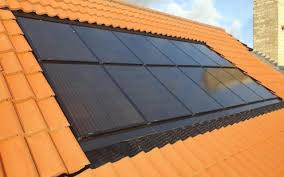
They say a slate roof will last 100 years, the problem being that Tarbraxian slate roofs were constructed 110 or 120 years ago. Toughened glass plates with stainless or copper nails would probably last longest, but would be very expensive and heavy. Overall I’m beginning to think about solar panels as an alternative to tiles or slates over a significant area of the roof. Glass and aluminium with stainless fittings won’t last forever but can be recycled with minimal loss, generate electricity and are easy to clean. An added advantage is the reduced moss buildup between the surface mounted panels where the sun and rain allow significant growth. The current, and I think original, slate roof on 93 Crosswood will probably need replacing in a few years, but with a bit of luck my finances will have recovered a bit and I’ll be able to put in some inset solar panels. They sit in plastic trays so they become part of the roof rather than just sitting on it. That reduces costs and prevents pigeons. They should work better if warm (but not hot),… I’m not sure about heat-loss and insulation. More research required. Ideally at that point I would add light pipes to brighten the inside rooms and a small Velux type window. There are only two rooms, plus bathroom and kitchen. I think they were built for the regular shale miners but being single bedroom, less suitable for large families. It is difficult to tell but I suspect life was seriously hard, badly paid and difficult to rise from. At the time of building the lofts were unoccupied, completely ignored and used only for cold water tanks. In the larger cottages a lodger or two could be accommodated in the roof space as was the case in our own home’s earlier period. The ‘room-in-roof’ solved the problem of how to house single men cheaply at the same time as controlling their behaviour. Noisy lodgers wouldn’t get the same assistance in food and laundry that the miner’s wife downstairs could offer. The back-to-back houses originally lacked bathrooms and toilets. They were smaller but must have had other characteristics unknown to me that precluded lodgers in the loft but in practice the back to back house attics were ignored. Accessed by a hatch and presumably a ladder they were un-floored and uninsulated, lacking heat and light for 100 years. With the aid of folding loft ladders and chipboard flooring they are gradually being converted and can add ⅓ of the house space just by raising the roof ties by 18”. They cannot easily be used for accommodation but are good for storage once the opportunity to bang your head is reduced. None I’ve seen have proper stairs though, which would make them 2 story houses which might conflict with planning regulations.
The sky is starting to look a little like it might snow, so I’ll go and get some logs in. The cat and Fiona also like the extra warmth, and it helps if the snow should bring the power-lines down. I’m glad to say that hasn’t happened in a while now, but getting complacent is the surest way of causing it.
It did snow, I'm writing this is a day or so later. That snow just sprinkled and melted. A good excuse for a fire though. I said to Fiona at the time that the small amount of sleet was unlikely to settle at 2° (the degrees symbol [°] I found again [shift-option-8] on the Mac Keyboard, having lost it for a few months so if you get a peculiar symbol there you'll know what it should be).
Being a bit cold outside I had a go at fixing a few indoor things. By the time I had disassembled a kettle and a LED wall light in the warm there were snowflakes the size of silver dollars settling on the car outside. Fortunately Fiona had not taken my weather forecast seriously and had stayed indoors.
Silver dollars LED lights and kettles; well I collect silver dollars (I now have two) and will welcome any others. I should remind the casual reader that snowflakes of that size are much lighter. The kettle was repaired and returned to the farm. The LED light had been on the outside of the tractor shed and disconnected for some years. I found the light worked but the sensor didn’t so I may have to find a new use for it. New ones are £12 so there’s a limit to how much refurbishment it is worth.
I’ve been meaning to put a daylight sensor in conjunction with the timer on the farm building. As it is I have to keep adjusting the timer. Here 55° North the days vary in length, from 7 to 17 hours of light. Daylight sensors can be wired in quite easily, so it’ll come on if it is dark and inside a set period of time.
I feel movement detectors are over-rated. Our outside house light has daylight and movement sensors and is endlessly being turned on by neighbourhood cats. Still, it is useful to illuminate visitors and our own arrivals. There are closed circuit cameras to provide a record of unusual events (like visiting dogs that chase our cats) and deliveries.
Slightly concerning is the unknown visitor who cut two of the four camera signal wires, unfortunately I hadn’t checked the footage and it was overwritten.
The next ones will be less accessible and have longer memory storage. I can only assume the perpetrator was fairly dim, as there would have been a record of the action for a week or so. I’m hoping the next system will have a tamper alarm. Somebody didn’t want them observing, so presumably they are worthwhile. Statistically this area is pretty quiet on the criminal front. I only set the cameras up for insurance purposes.
On a different subject entirely, I am reminded that as a child I fell out of several windows and trees. No great damage was incurred, but although each was an unpleasant few minutes I don’t know if that was what gave rise to a general feeling of fear whenever I am subject to heights above ten or twelve feet. Fortunately the effect has only been for the last few decades of this lifetime. I call it acrophobia as there’s no dizziness and it’s a bit more complicated than a simple fear of falling. Aircraft and stepping stones don’t have the effect, bridges and mountains do. Swimming pools and harbour walls don’t, which is odd because I’ve only died (temporarily) from swimming pool falls as far as I can remember.
I don’t have any other irrational fears as far as I know, although I’d question the rationality of people who stand on cliff edges and jump out of aeroplanes. I exclude my wife from this analysis because although she liked doing both of those, I don’t want to upset a stable relationship. I know otherwise rational people who are afraid of mice, earwigs, balloons and public speaking; none of which bother me, so I’m prepared to say that irrational fears do not an irrational person make.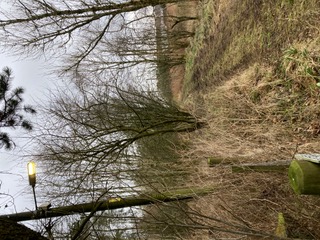
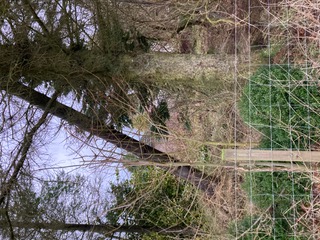
The weather continues mild, considering the now distant memory of four foot snow in the middle of the village but the wind has been more noticeable over the last decades. Above you'll find the latest victims which will need dealing with. The top of the lamp post has been gently drifting west, which is mostly poor footings but gets worse when a gale wiggles it, and above that, one of the trees in the garden with shallow roots which a recent easterly wind tilted. We have had to deal with several fallen trees over the years, mainly with shallow roots and soggy soil caused by the foundations that permeate the garden both the lamp-post and the tree were near foundation walls. There used to be another 6 cottages in our garden and another 32 in the woodland. All demolished after the shale mine closed leaving broad 'stacked brick' foundations which can occupy ⅓ of the space where the houses were. That makes new uses for the land difficult, but on the upside the houses were made with lime based mortar so I can excavate fresh bricks from almost everywhere when I want more road or garage base.